BehaviorTables
BehaviorTables é uma poderosa ferramenta que permite que sua aplicação tenha comportamentos.
Essa ferramenta fornece automação. Atualmente a partir da versão Disfox 0.1.0, só pode ser aplicada em comandos slash.
As BehaviorTables são basicamente tabelas que definem comportamentos para comandos slash, e futuramente, para Eventos.
com essa ferramenta, você pode permitir, bloquear usuários sobe o uso de comandos específicos, ou executar ações quando um comando é executado com sucesso.
Ela fornece o conceito de comportamento aclopável, em componentes Disfox.
Atualmente, BehaviorTables é apenas compativel com SlashCommands, apenas no modelo Disfox.
Importações
// esm
import { BehaviorTable, BehaviorContext } from 'disfox';
Uso
Exemplo criação
import { BehaviorTable, BehaviorContext } from 'disfox';

const table = new BehaviorTable({
    context: BehaviorContext.SlashCommand,
    onViolate: {
        alert: {
            content: "This command is not available for you.",
            flags: 64 // Ephemeral (optional)
        },
        log: {
            content: "Usuario tentou ultilizar comando restrito.",
            level: "warn"
        }
    }
});
context: Contexto da tabela. Recebe o enumBehaviorContext.onViolate: O que fazer ao tentar violar.
Exemplo completo:
import { SlashService, BehaviorTable, BehaviorContext, SlashTag } from "disfox";
import fs from "fs/promises"
import path from 'path'
import { fileURLToPath } from "url";

const dn = path.dirname(fileURLToPath(import.meta.url));
const filepath = path.join(dn, '..', 'data', 'restricted.json');

const restricted = await fs.readFile(filepath, 'utf-8')
const parsed = JSON.parse(restricted)

const table = new BehaviorTable({
    context: BehaviorContext.SlashCommand,

    restricted: {
        userId: parsed
    },

    onViolate: {
        alert: {
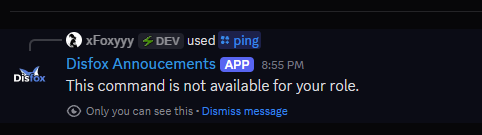
            content: "This command is not available for you.",
            flags: 64 // Ephemeral (optional)
        },

    }
})

const command = new SlashService.Command("ping")
    .description("replies with Pong!")
    .dock(table)
    .action(async interaction => {
        await interaction.reply("Pong!")
    });

export default command;
Resultado
Valor de entrada
Este exemplo mostrou apenas algumas ações que podem ser executadas. abaixo está uma explicação de todos os valores que o
valor onViolate pode receber:
{
    onViolate: {
        alert?: {
            content: string,
            flags?: number
        };
        sendDM?: {
            content: string,
        };
        function?: (...args : any[]) => void;
        applyTimeout?: {
            reason?: string,
            duration: number
        };
        applyVoiceMute?: {
            mute: boolean,
            reason?: string
        };
        kickOfGuild?: {
            reason?: string
        };
        banOfGuild?: {
            reason?: string,
            deleteMessageSeconds?: number
        }
}
}
| Action | Description | Properties | Example |
|---|---|---|---|
alert | Sends an alert message when a violation occurs. | content, flags? | alert: { content: "You cannot use this command." } |
sendDM | Sends a direct message to the user. | content | sendDM: { content: "You have been punished." } |
function | Executes a custom function when a violation is detected. | (...args: any[]) => void | function: (...args) => console.log(args) |
applyTimeout | Applies a timeout to the guild member. | duration, reason? | applyTimeout: { duration: 60000 } |
applyVoiceMute | Mutes or unmutes the member in voice channels. | mute, reason? | applyVoiceMute: { mute: true } |
kickOfGuild | Removes the member from the guild. | reason? | kickOfGuild: { reason: "Rule violation" } |
banOfGuild | Bans the member from the guild. | reason?, deleteMessageSeconds? | banOfGuild: { deleteMessageSeconds: 3600 } |